Affichage des articles dont le libellé est hypnosis. Afficher tous les articles

jeudi 30 novembre 2017

Spectacle "Hypnofolies", Cyrille Arnaud, un des hypnotiseurs les plus brillants de sa génération.


L'affiche du spectacle.


J’ai vu hier soir le spectacle d’hypnose « Hypnofolies » de Cyrille Arnaud. Cyrille Arnaud est parfait quant à sa maîtrise des techniques de l’hypnose et aussi par rapport à sa gestion des hypnotisés sur la scène. Même, à certains moments, le spectacle devient tellement fort que le public a peine à y croire et se demande si l’hypnotiseur n’est pas de mèche avec les spectateurs hypnotisés. Donnons des exemples : une dame sur scène, pendant toute une partie de la soirée, téléphone… avec sa chaussure… à Céline Dion ; un monsieur se prend pour un homme invisible et vole des chaussures dans la salle ; un autre oublie son prénom et est persuadé qu’il s’appelle Maxime, etc. (je ne vous dévoilerai pas tout ; il faut absolument que vous veniez voir ce spectacle et votre vision sur l’hypnose, même si vous êtes très sceptique, si vous ne croyez pas à la réalité de l’hypnose, votre opinion pourrait totalement changer).

Cyrille Arnaud n’a pas seulement une grande maîtrise de son art mais il a aussi beaucoup d’humour et de sens de la répartie. C’est, à mon avis, indispensable pour un spectacle d’hypnose car, s’il n’est pas pimenté par des pointes de petit délire amusant, des blagues légères, il peut devenir ennuyeux, même s’il est très bon techniquement.

Il faut absolument le mentionner aussi : contrairement à certains hypnotiseurs, Cyrille Arnaud n’a pas de complice dans la salle. Et sa prestation en est d’autant plus exceptionnelle et bluffante.

L’avis que je vous donne n’est pas celui d'un novice. Je pratique moi-même l’hypnose depuis 1983 et je suis allé voir beaucoup des grands hypnotiseurs de notre temps afin de me perfectionner : Dominique Webb, André Revol, Jean Gontier, Danny Dan, Messmer, Hervé Barbereau, etc. J’ai eu aussi comme professeurs, dans des stages que j’ai effectués, deux hypnotiseurs de renom, Olivier Lockert et Bertrand Millet.

Le seul modèle auquel puisse être comparé Cyrille Arnaud  est celui du plus grand maître de l’hypnose du dix-neuvième siècle, le belge Donato, qui a hypnotisé à l’époque des milliers de personnes sur scène.

Je rappelle pour finir que Cyrille Arnaud est un hypnotiseur de spectacle, un très grand, mais que l’hypnose est un phénomène incroyablement puissant et utile dans la pratique médicale. Des centaines d’hypnothérapeutes en France guérissent des milliers de gens de leurs phobies, de leurs addictions, de leurs douleurs, etc. Elle est employée aussi par des dentistes pour les patients qui ne supportent pas l’anesthésie.

Si vous voulez en savoir voir plus sur le sujet, je vous conseille bien sûr mon livre Initiation au mentalisme, à l’hypnose et à la mnémotechnie mais aussi l’ouvrage d’Anthony Jacquin, L’art de l’hypnose impromptue  qui pour moi est la meilleure synthèse actuelle en français sur le sujet.


Voilà. C’est tout pour le moment. Amitiés à tous.

lundi 30 octobre 2017

Numéro d'octobre 2017 de la revue "The Linking Ring" avec un important article sur Derren Brown.


Le numéro de la revue "The Linking Ring" d'octobre 2017 sur Derren Brown.

La revue de l'"International Brotherhood of Magicians", The Linking Ring, consacre un important article illustré de très belles photographies au mentaliste anglais Derren Brown : Derren Brown, No Longer a Secret par Simone Marron (p. 18 à 25).

Si vous désirez en savoir plus, contactez-moi en message privé.

Voilà. C'est tout pour aujourd'hui. Amitiés à tous !

mardi 29 août 2017

Tentative de bibliographie des ouvrages de mentalisme de spectacle en langue française ou recension de ce que je possède dans ma bibliothèque ! (cinquième partie) (lettre B, Bastardi Daumont John, suite).


John Bastardi Daumont.


J’ai pensé que, comme il paraît beaucoup de livres dans le secteur du mentalisme de spectacle, il serait intéressant de composer une bibliographie sur le sujet, mais seulement des ouvrages en langue française. Je me baserai pour cela sur ma bibliothèque et sur le catalogue des différents éditeurs et magasins de prestidigitation. Cependant, je ne traiterai pas de différents domaines plus pointus que j’ai déjà abordés sur des sites ou sur mon blog : la mnémotechnie et les book tests  sur lesquels j’ai déjà fait des recensions dans Virtual Magie, l’hypnose et la télépathie simulée, dont j’ai déjà donné des bibliographies dans ce blog.

Cet article est la suite de celui-ci.

Lettre B (suite)


Le français John Bastardi Daumont est à la fois avocat et prestidigitateur, élève de Jean Pierre Vallarino  et ayant participé à la piteuse aventure de la revue Exortisma. Contrairement à beaucoup de prestidigitateurs (voir le débat sur le site Virtual Magie), je trouve ses livres dignes de considération et notamment ce deuxième tome des Secrets d'un mentaliste.


J’ai traité de ce livre dans différents articles de mon blog. Je vous indique l’adresse du premier article. John Bastardi Daumont présente par exemple une description de l’histoire de l’hypnose tout à fait pertinente, je dirais même la meilleure que j’ai lue jusqu’ici.

Comme d’habitude, pour que vous vous fassiez une idée par vous-mêmes, je vous en donne la table des matières :

Convicere : cet homme est un magicien, par Frédéric Monera

Seducere : détourner autrui de son chemin, par Patrick Berger

Avant- propos

Le levier de l’attraction : la suggestion

« Par ici mon petit chien » : la domestication future du consommateur
L’animal est- il bien dompté ? Réagit- il bien au « charisme » de l’émetteur ? Vérifions : le neuromarketing
L’hypnose, force de frappe charismatique
Du magnétisme animal à l’hypnose ericksonienne
L’origine du catalyseur de charisme : le mesmérisme
De l’optimisation charismatique d’un homme à la réelle action hypnotique sur autrui
De l’hypnose thérapeutique à la modification du comportement d’un individu sans son consentement
La maîtrise de l’attention d’autrui par l’utilisation de ses automatismes : la rupture de pattern :
1.       " Dis- moi à quel endroit je peux te voler."
2.       L’attraction de l’attention par la loi de l’intérêt

De la suggestion à la séduction

Le mirage du culte de l’apparence
Les échanges sont avant tout émotionnels
Quelques expériences d’échauffement
1. Les interactions entre les mains et le visage
2. Le buste
3. Les jambes, le flanc et le dos
4. L’écoute
5. Les patterns contaminants : exemple, le sourire
6. La projection émotionnelle
7. Les expériences menées par la CIA sur les vertus de la suggestion
8. Méthode Coué et sophrologie
9. Le processus de recall
10. le développement de l’intensité du regard
11. L’oreille pour miroir
La speed séduction : les ruses de Sioux

De la séduction à la fanatisation

Le contrôle indirect dans une surface sociale restreinte : génération d’un individu alpha
La programmation d’un alpha
Indifférence et empathie simulée
De l’espiègle individu alpha isolé à la naissance d’une passion fanatisante
La foule a un caractère
Suivre le caméléon jusqu’au suicide : un ordre, 900 morts

Séduction 2.0

Un laboratoire à échelle humaine
Passer de rat de laboratoire à expérimentateur : les bons outils
Du laboratoire au jeu
Les limites du jeu
Les erreurs à ne pas commettre
Première faute : la mitraillette du clic
Deuxième faute : étaler ses états d’âme
Troisième faute : mal maîtriser les demandes  de mises en relation
Quatrième faute : mal gérer sa communication visuelle
Cinquième faute : tout dire
Sixième faute : se couper de la vie réelle
Septième faute : s’affranchir de l’information
Du jeu à la science

Voilà. C’est tout pour le moment. Amitiés à tous.


dimanche 6 août 2017

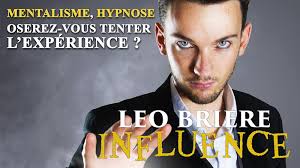
Compte rendu de « Influence » du mentaliste et hypnotiseur Léo Brière.


Une photographie de l'artiste.

« Influence » de Léo Brière, qui se joue actuellement au Théâtre de la Contrescarpe dans le cinquième arrondissement de Paris, est mon coup de cœur en spectacle de mentalisme de cet été. Pour moi, une nouvelle étoile est née dans ce monde du mentalisme où la concurrence est rude. Léo Brière est jeune encore mais par ce show, il montre que déjà il n’a rien à envier à ses illustres aînés.
Pourquoi tant de compliments ? Qu’est-ce qui distingue le spectacle de Léo Brière de celui de ses collègues. Tout d’abord, il a eu l’ingénieuse idée de combiner dans un même show hypnose et mentalisme (à la manière de ce que fait le très célèbre mentaliste américain Richard Osterlind), ce que très peu de mentalistes pratiquent en France. Dans le pays de Voltaire, on est soit hypnotiseur, soit mentaliste. C’est dommage parce que les deux disciplines sont complémentaires.
La deuxième constatation évidente est que Léo Brière est à la fois un excellent hypnotiseur et un mentaliste qui sait à merveille impressionner et perturber son public.
Pour que vous perceviez un peu en quoi consiste le contenu du spectacle, pour que vous accouriez le voir ( ! ), je vais en premier lieu décrire la partie hypnose et ensuite présenter la partie mentaliste.
Léo Brière commence en ce qui concerne l’hypnose par des expériences qu’on pourrait appeler classiques : catalepsie des bras, visionnement d’un rêve comique, etc. Puis, au fur et à mesure de la séance, il crée des phénomènes de plus en plus extraordinaires (je ne vous les décrirai pas pour que vous en ayez la surprise quand vous viendrez assister au show)
Je tiens à souligner deux points importants qui montrent les grandes qualités d’hypnotiseur de Léo Brière : 1) Contrairement à certains de ses confrères, il n’a pas de complice dans la salle. 2) Surtout, il est toujours bienveillant avec ses spectateurs et il prend soin d’eux. A la fin du spectacle, il les déconditionne systématiquement, ce qui est indispensable. Selon moi, si ces deux conditions ne sont pas réunies dans un show d’hypnose, celui-ci sera toujours mauvais.
Mais Léo Brière est aussi mentaliste. Quand je suis venu le voir, il a vraiment gâté son public avec des tours exceptionnels et inexplicables. Là aussi, je ne peux pas tout citer. Il y a eu beaucoup de divinations incompréhensibles : le mentaliste a deviné un nombre dit par un spectateur, un dessin dessiné par un autre spectateur, un mot lu dans un livre, etc. Il a ensuite flirté avec l’occulte en utilisant la planchette ouija pour des effets de voyance, puis en faisant croire à un spectateur sur scène qu’il le touchait à plusieurs reprises sur son corps et sur son visage, alors qu’il ne l’avait jamais été.
Pour les amateurs de magie, il y a ce qui s’appelle des climax à la fin, au nombre de quatre. Ces climax sont plus forts encore que tout le reste car ils défient véritablement les lois de la raison ; le spectateur se dit en sortant : « Non, c’est impossible. »
Sur un plan plus matériel, la salle était pleine, le public était enthousiaste et réactif, et Léo Brière est resté de longues minutes à la sortie du théâtre pour répondre aux questions de tous les spectateurs qui le désiraient.

Voilà. C’est tout pour le moment. Amitiés  à tous ! 

dimanche 23 juillet 2017

Résumé du contenu du blog de Jean-François Gérault sur le mentalisme, le développement personnel, l'hypnose et la mnémotechnie.


Une photographie du blog.

Ce blog a pour but d'initier au mentalisme, au développement personnel, à l'hypnose et à la mnémotechnie.

Les thèmes qui y sont abordés sont le cold reading, la double réalité, le cumberlandisme, les chair tests, les book tests, les bank nights, la télépathie, les ACAAN, le pliage Acidus Novus, les méthodes de développement personnel.

J'ai écrit un ouvrage spécifique pour les gens qui débutent dans ces domaines : Initiation au mentalisme, à l'hypnose et à la mnémotechnie.

J'ai deux pages Facebook consacrées à ces sujets dont une entièrement dévolue à mon livre : Initiation au mentalisme, à l'hypnose et à la mnémotechnie et l'autre intitulée Jean-François Gérault, mentaliste écrivain.

Je fais des soirées privées sur le thème de l'hypnose et du mentalisme. J'endors au moins cinq personnes par soirée. Je montre des expériences d'anesthésie, de régression dans le temps, d'oubli de chiffre au réveil.

J'écris des articles pour le site de prestidigitation de référence français Virtual Magie.

Mon blog est le seul où vous trouverez une initiation complète à ces 4 domaines : le mentalisme, l'hypnose, la mnémotechnie, le développement personnel.

Vous pouvez ensuite me contacter par Internet et prendre des cours avec moi.

Mon blog est très pédagogique et vous pourrez très rapidement pratiquer des expériences de mentalisme, d'hypnose ou de mnémotechnie.


Voilà. C’est tout pour le moment. Amitiés à tous.

mercredi 24 mai 2017

Hypnosis (part 3), Hypnose (troisième partie)


“La Revue de la prestidigitation” (“The Conjuring Review”), January 2016.


Since I have noticed that my blog has english-speaking followers, I’m going to publish a short series of article in that language. It will be the translation of an extensive article that I wrote in January 2016 for “La Revue de la prestidigitation” (“The Conjuring Review”). The translation has been done by the mentalist Eric Bertrand co-author of “Douceurs mentales” (“Mental Sweets”)


Hypnosis: History and Techniques

The hypnosis process, be it in the street or during a private party, comprises four crucial steps, known as the “Four As”:  Agreement, Announcement, Accomplishment and Awakening. You can see Agreement and Announcement in the previous article of the blog.

3) Accomplishment
Here is the key principle : « What I have announced, what I have promised, I deliver. »
Accomplishment is a four-step process.  You start with having the subject go through a specific pre-hypnotic test (step one) and you have him fall backwards (step two). You follow with the suggestion that his eyelids are glued together so that he cannot open them however hard he tries (step three) and eventually you start the hypnotic trance (step four).

a)      Choose among five pre-hypnotic experiments.
Let me give you a personal piece of advice here. Do not hesitate to  count (up or down) a lot. Count to three before performing the elevator test for example, count again before the backwards fall, again before the stuck eyelids test and again before the hypnotic trance.
Here’s a short list of five pre-hypnotic tests of which you will choose only one to perform (the one you prefer or the one that has yielded the best results in the past):
·         Stuck fingers
The subject holds his hands together, with the first fingers pointing forward. Ask him to spread the tips of the first fingers, leaving a distance of around one or two centimeters between them. Start counting from one to three. Soon the fingertips will move towards each other and will eventually meet.
·         Elevator
Ask the subject to extend his arms out, palms facing the sky. Suggest that his right arm is getting lighter and lighter while his left arm is getting heavier and heavier. Do the count.
·         Flexibility
The subject extends his arms in front of him. Instruct him to move back his right arm, still extended, until it cannot go further. Subject comes back into his original position. Ask the subject to do the same move but this time in thought only (no physical execution) and to reach a point further back. Then instruct the subject to actually move his arm again and you will notice that he is able to go much further back than in the first instance!
·         Stuck hands
Ask the subject to join his hands while keeping his elbows spread. Suggest that the hands are stuck together, that he cannot separate them. Do the countdown.
·         Ring with fingers
Tell the subject to join his right and left thumbs while also joining his right and left first fingers so that the four fingers make like a ring or circle. Suggest that a tremendous amount of energy is flowing inside that ring, that it flows through the subject’s fingers. Do the countdown and tell the subject that he cannot separate his fingers.

b)      Backwards fall
Perform the backwards fall experiment right after the pre-hypnotic test. You go and stand behind the subject and you rest your hands lightly over his shoulder blades. Ask the subject to keep his feet tightly together, to close his eyes and suggest that he will soon feel the inclination to fall backwards. Physiologically, when we keep our feet together and we close our eyes, we all tend to fall backwards (see John Fisher’s book Body Magic). Count to three along the following lines: “One - You feel my hands over your shoulder blades and, in a few moments, you will be drawn backwards. Don’t be afraid, I’m here to hold you.” “Two - You are feeling more and more inclined to fall backwards.” “Three - You fall backwards and I am holding you.” Please note the presence of the Ericksonian “and” in the sentence “One - You feel my hands over your shoulder blades and, in a few moments, you will be drawn backwards.” The “and”, which is normally a coordinating conjunction and which implies addition, takes a different meaning here: it becomes the equivalent of the conjunction “thus” which implies consequence. The subliminal message conveyed is therefore: “You feel my hands on your shoulder blades thus, in a few seconds, you will feel inclined to fall backwards.”
The subject actually falls backwards and you grab him, assisting him in his fall.

c) Hand to face, stuck eyelids and hypnotic sleep
You ask the subject to extend his arm in front of him and to stare at his palm. You suggest that, progressively, his hand will move towards his face and that when the hand reaches the face, his eyes will close, his eyelids will remain stuck together inducing a deep hypnotic sleep. And actually, the hand starts moving towards the face of the subject. You count: “One - Your eyelids feel very heavy.” “Two - They are heavier and heavier and they are like glued together.” “Three - Now your eyelids are solidly stuck together, they are very, very heavy. You cannot move them and you enter a deep and relaxing sleep.” This suggestion is reinforced by the use of what French hypnotist Marcel Rouet named the “law of inverted effort”: the more the hypnotised subject tries to do something, the less he is successful. This is a natural psychological law: for instance, the more one tries to calm down, the more one feels agitated; the more one tries to overcome stage fright, the more panic one feels, etc. And more generally, the faster we try to do something, the more nervous we tend to get and the less successful we are. This is why your subject, though seriously trying to open his eyelids will be unable to do so.

d) Hypnotic trance
Three experiments are proposed herewith, among many possibilities.
·         Hot and cold
Explain to your hypnotised subject that he has the capability to travel in his mind. In a few seconds, he will find himself in Norway. Count to three and the subject will start feeling a severe cold. “One - You are in Norway, and the snow is falling hard.” “Two - The snow is all over the place and the air is extremely cold. “ Three - The temperature is way below freezing and you feel colder and colder. Your whole body is shaking with cold.” At this stage, the subject will start shivering more and more severely.
Suggest a change of scenery to your subject. Remind him that, in his current hypnotic trance, he can instantly travel anywhere he wants. Explain that he is now located in the Sahara desert, a very warm place. “One - The sun is burning hard and the air is extremely hot around you.” “Two - You are very hot and sweat is bathing you.” “The air is scalding now, even in the shade, and you are sweating profusely and constantly.” Your hypnotised subject will actually start sweating. Help the subject forget this sensation and move to the next experiment.

·         Anesthesia
For this experiment, you need a small needle, such as a sewing needle or better a hypodermic needle. Instruct the subject to focus intently on his right arm and go ahead with the following count: “One - Your arm is progressively becoming numb, as if it were covered with leather instead of skin.” “Two - Your right arm is totally numb, so very numb that it feels nothing, it feels no pain at all.” “Three - Your arm is now so numb that you don’t even feel the air caressing it; your arm is now completely inert and insensitive.”
You can now prod the arm with the tip of the needle. If the subject has been properly hypnotised, there will be absolutely no reaction, no skin reflex. You can follow with carefully sticking the needle under the skin of the subject and therefore show that a hypnotised subject feels no pain at all.
To end the experiment, verbally guide your subject back to reality.

·         Memory loss
You are going to make your subject forget the number 9 after waking up (note: avoid making the subject forget his name. Although possible, this is quite a traumatic experiment that I don’t recommend.)
“One - In a moment you will wake up and you will completely forget about the number nine.” “Two - The more you will try to remember that number nine, the more it will evade you.” “Three - Now, you have completely forgotten about the number nine.”
At this stage, you progressively bring your subject back to reality. This is important. I recomment that you add another count. “ One - Now you are going to wake up from this pleasant sleep. You will feel very relaxed, very comfortable, like after a good nap.” “Two - You can now start to open your eyes.” “Three - You open your eyes and you feel good, comfortable, relaxed and happy.”


4) Awakening
You now perform the post-hypnotic test of the number 9 amnesia. This test is quite funny and is perfect in order to lighten the mood. When the subject counts out loud the numbers from 1 to 10, he will skip the number 9, moving from 8 directly to 10. The same thing will happen if you ask the subject to count his fingers: he will shift from one finger to the next skipping nine. Unbelievably, the subject will be unable to tell you the result of a simple addition such as 5+4!
Later on, the memory of the number 9 will come back naturally and without effort.

To finish, and this is a crucial step, ask the subject how he feels and what he felt during the experiment. This will allow you to assess your session and the subject to gather his wits and completely come out of his hypnotic state. Never let a subject go without performing this evaluation with him. This will be my last advice for you.


 That's  all. I hope you  enjoy it.


Hypnosis (part 2), Hypnose (deuxième partie).


The Hypnotist "Abbé Faria"


Since I have noticed that my blog has english-speaking followers, I’m going to publish a short series of article in that language. It will be the translation of an extensive article that I wrote in January 2016 for “La Revue de la prestidigitation” (“The Conjuring Review”). The translation has been done by the mentalist Eric Bertrand co-author of “Douceurs mentales” (“Mental Sweets”)

Hypnosis: History and Techniques

The hypnosis process, be it in the street or during a private party, comprises four crucial steps, known as the “Four As”:  Agreement, Announcement, Accomplishment and Awakening.

1)      Agreement.

You meet someone in the street to whom you state that you perform hypnosis. This is the educational part during which you explain what hypnosis really is: it is not something bizarre; it is a particular state of consciousness that people experiment several times a day, without even noticing it, when one reads and doesn’t pay attention to anyone speaking, when one is totally focused on driving a car, when one runs or meditates, etc. The only difference the subject will feel is that he will be guided while in hypnotic trance. You also explain that, unlike what most people think, unlike what the subject may have seen or heard, he will not lose his free will. You also tell him that, unlike what may happen in some shows by Messmer or other hypnotists, you will never belittle the subject nor ridicule him.

This part is what Jean-Emmanuel Combe names “pre-talk” in his book La Voix de l’Inconscient. In his own words: “As crazy as this may seem, pre-talk is the key to your success.” A good pre-talk allows the subject to alleviate his fears and fantasies regarding hypnosis and therefore to be less tense, more relaxed and ready to follow your instructions with grace.


2)      Announcement.
According to hypnosis theory, any significant action that is to happen needs to be previously announced to the subject. Always give some timing indication and stick to it. And always act according to the announcement. Describe clearly the pre-hypnotic experiment you are going to carry out: for example lightness of right arm and heaviness of left arm (you announce one of the five typical pre-hypnotic phenomena: flexibility, stuck hands, ring, stuck fingers or elevator). Explain that the subject will fall into a comfortable sort of sleep. The tone of your voice is key: you must sound convinced and convincing! 

Here is one part of the induction described by Jean-Emmanuel Combe in his book La Voix de l’Inconscient: “You will remain perfectly conscious and perceptive. It is simply through your imagination and your focussing that you will experience what is known as hypnotic  phenomena. […] Everything becomes possible thanks to hypnosis. And even when I’ll say the word “sleep” in a short while, it will have nothing to do with sleep as you know it. It will just be a state of deep relaxation, in which you will remain perfectly lucid. You will keep on hearing everything, feeling everything. The only difference, if you accept that, is that you will experience sensations that were unheard of so far.” Explain (I do that in every session) that you will gratify the subject with a “hypnotic gift”: you will allow him to live, while under hypnosis, one of his dearest dreams.  I have for example made a car racing fan experience the pleasure of driving a Ferrari on the Imola racetrack, allowed a young actress to co-star with Isabelle Huppert in a movie, etc.

 That's  all. I hope you  enjoy it.